
Introducing the Owl Labs Meeting System: How the Recovery Hub Is Strengthening Hybrid Group Care
Group therapy has always been an important part of outpatient treatment. It gives clients a place to speak openly, learn from others who understand what they’re going through, and build the connection and accountability that can support long-term recovery. As more clients participate through our telehealth program, our goal at the Recovery Hub is to make sure that sense of connection carries into hybrid groups, too. Whether someone is sitting in the group room or joining from home, they should be able to feel present and involved in the conversation. That goal led us to introduce the Owl Labs Meeting System, a 360-degree conferencing camera designed to create a more connected experience for clients participating in our hybrid group sessions.
Why Hybrid Group Care Matters
Hybrid groups are a relatively new model in substance use treatment, but the early evidence is encouraging. The flexibility of virtual care can make treatment easier to access, while having an in-person component can help preserve some of the connection and engagement that make group therapy meaningful. A 2024 study out of the Mayo Clinic Department of Psychiatry and Psychology found that clients in hybrid outpatient groups had meaningfully higher treatment completion rates than clients in virtual-only groups (Oesterle et al., 2024). Giving someone a convenient way to attend is important, but creating an environment where they remain engaged and continue participating is just as important.
A related survey of clients across in-person, hybrid, and virtual-only groups found that clients in hybrid groups reported a sense of connection and program satisfaction close to what in-person clients reported, and consistently higher than virtual-only clients (Bormann et al., 2024). For group-based treatment, where conversation, shared experiences, and relationships with others are central to the experience, that finding is especially relevant.
A broader scoping review of hybrid substance use disorder group models echoed the same pattern: hybrid groups tend to perform similarly to fully in-person groups, and better than groups that are entirely virtual (Trimble et al., 2025).
For us, that research confirms something we already believed. Recovery does not happen in isolation, and it should not depend on which side of a screen someone happens to be sitting on. A hybrid model lets us meet clients where they are, whether that is a packed weekday schedule, a lack of reliable transportation, or a health concern that makes travel difficult, without asking them to give up the shared presence of a group.
The Real Challenge Behind Hybrid Groups
The harder question has always been how to make a hybrid group actually feel like one group. Research on videoconferencing in behavioral health consistently points to the same obstacle: much of what makes a therapeutic conversation work, eye contact, body language, who is leaning in or pulling back, is easy to lose over a standard laptop camera (Thomas et al., 2021). In a typical hybrid setup, remote participants see a static, wide shot of a room and often cannot tell who is speaking, while in-person clients can forget the remote members are even there. Over time, that gap can quietly work against the trust a group is trying to build.
How the Owl Labs Camera Changes the Room
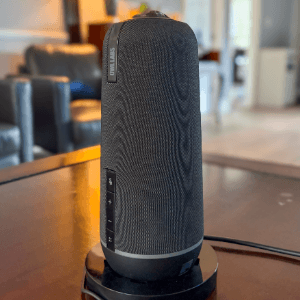
The Owl Labs Meeting System addresses that gap directly. It is a 360-degree camera and microphone array that sits in the center of the room and automatically highlights whoever is speaking. This helps remote clients actually see the person talking, not just a wide angle of the whole space. The device also gives a continuous panoramic view of the entire room, so clients joining virtually can still pick up on the body language and side conversations that are such a normal part of group dynamics. For the clients sitting in the room, the technology stays out of the way. There is no camera to angle, no laptop screen to work around. The group can simply meet.
How We Are Implementing It at Recovery Hub
We have started rolling out the Owl Labs system in our hybrid outpatient groups. Clinicians have been trained on how to run a session with mixed in-person and remote attendance, including how to open space intentionally for remote clients to speak. This is especially important since research on hybrid models has shown that facilitation style matters as much as the technology itself. This work builds directly on the telehealth foundation we have spent the last several years developing. We have written before about The Role of Telehealth in Modern Addiction Recovery, and this new hardware is really an extension of that same commitment: using technology to widen access without narrowing the quality of care. It also connects to the community piece we discussed in Why Community Support Matters in Long-Term Recovery, because a hybrid group is only as strong as the sense of belonging every member feels, whether they are in the chair across the room or the one on the screen.
A Small Piece of Technology, A Larger Commitment
Every tool we bring into a group room has to answer one question: does this help a client stay connected to the people who are helping them recover? For hybrid group therapy, the Owl Labs Meeting System is one clear answer to that question. It is a small piece of equipment doing a fairly large job, making sure that no matter how a client joins a group, they are seen, heard, and included as a full member of the room.
If you have questions about our hybrid group options or want to know whether this format could work for you or someone you care about, our outpatient team at Recovery Hub is glad to talk it through.
References
Bormann, N. L., Stoppel, C. J., Arndt, S., & Oesterle, T. S. (2024). Patient perceived impact of outpatient group substance use disorder treatment in a hybrid model or virtual-only model relative to in-person delivery. Substance Abuse and Rehabilitation, 15, 223–232. https://doi.org/10.2147/SAR.S481447
Oesterle, T. S., Bormann, N. L., Ochal, D. A., Arndt, S., & Breitinger, S. A. (2024). Transitioning virtual-only group therapy for substance use disorder patients to a hybrid model. Substance Abuse and Rehabilitation, 15, 73–78. https://doi.org/10.2147/SAR.S460024
Thomas, N., McDonald, C., de Boer, K., Brand, R. M., Nedeljkovic, M., & Seabrook, L. (2021). Review of the current empirical literature on using videoconferencing to deliver individual psychotherapies to adults with mental health problems. Psychology and Psychotherapy: Theory, Research and Practice, 94(3), 854–883. https://doi.org/10.1111/papt.12332
Trimble, E. A., Bormann, N. L., Kalata, A. H., Gerberi, D., Arndt, S., & Oesterle, T. S. (2025). Hybrid virtual group model for substance use disorder therapy: A scoping review. Substance Abuse and Rehabilitation, 16, 137–146. https://doi.org/10.2147/SAR.S518266
